Programming Languages Calendar
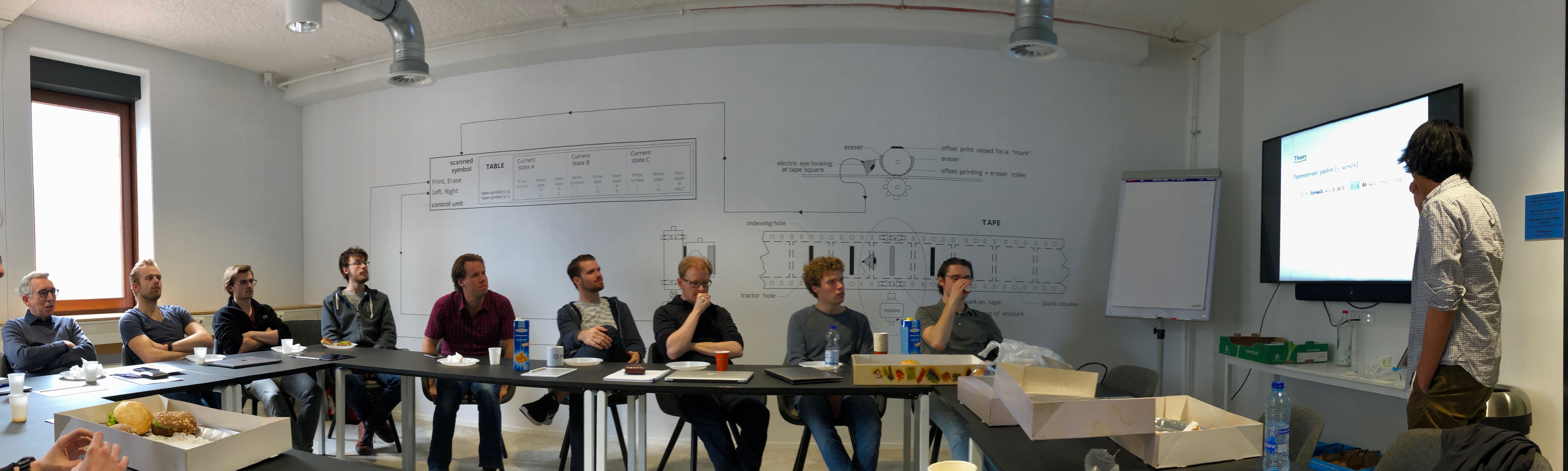

The PL group organizes a weekly lunch seminar on Wednesdays from 12:00 to 13:00 in which one of the group members or a visitor gives a talk. Occasionally we have `progress' lunches in which everyone gives an update about what they are doing.
To subscribe to our calendar, use the following link: https://pl.ewi.tudelft.nl/pl-events.ics
To edit the events, refer to the event instructions.
Upcoming Events
MSc Defense
Higher order pattern unification using scope graphs
Tudor Andrei
Monday, 02 November 2026 @ 10:00 - 11:30
28 - 1.W510 Banach
PhD Defense
Language-Parametric Editor Services from Language Specifications
Daniel A.A. Pelsmaeker
Wednesday, 11 November 2026 @ 17:30 - 19:00
Aula - Senaatzaal
Available Slots
The current slots are currently available for seminar. Please reach out if you would like to give a talk!
- Wednesday, 21 October 2026 @ 12:00 - 13:00
- Wednesday, 28 October 2026 @ 12:00 - 13:00
- Wednesday, 04 November 2026 @ 12:00 - 13:00
- Wednesday, 18 November 2026 @ 12:00 - 13:00
- Wednesday, 25 November 2026 @ 12:00 - 13:00
- Wednesday, 09 December 2026 @ 12:00 - 13:00
- Wednesday, 16 December 2026 @ 12:00 - 13:00
- Wednesday, 23 December 2026 @ 12:00 - 13:00
If you are a member of the group, refer to the event instructions on information about how to claim a slot.
Past Events
PhD Defense
Language-Parametric Editor Services from Language Specifications
Daniel A.A. Pelsmaeker
Wednesday, 11 November 2026 @ 17:30 - 19:00
Aula - Senaatzaal
MSc Defense
Higher order pattern unification using scope graphs
Tudor Andrei
Monday, 02 November 2026 @ 10:00 - 11:30
28 - 1.W510 Banach
Seminar
Beyond Text: Rethinking Code Interaction and Exploration
Mauricio Verano Merino
Wednesday, 14 October 2026 @ 13:45 - 14:45
28 - Social Data Lab
Abstract: Nowadays, AI agents can generate code, but our core interaction with software remains tethered to an old paradigm: editing linear, static text. While surrounding tools have evolved exponentially, the ways developers visualize, manipulate, and track code remain largely unchanged. This creates persistent friction both when domain specialists interact with custom language abstractions, and when developers explore ideas fluidly without tool overhead.
In this talk, I will present two programming interfaces that break away from static text editing. First, I introduce Kogi, a tool that automatically derives visual block-based language interfaces directly from context-free grammars. Second, I present GhostIDE, an environment designed for exploratory programming that handles version control seamlessly in the background without interrupting creative flow. Together, these tools show how language-parametric interfaces and friction-free tracking can improve how developers and domain experts construct and explore software.
Bio: I'm an Assistant Professor in Computer Science at VU Amsterdam and founder of the Analogue Intelligence Lab and Sports Intelligence Lab. My research focuses on end-user programming, domain-specific languages, and software environments for creative computing. My work sits at the intersection of Software Engineering and Human-Computer Interaction—building interactive systems, live-coding tools, and programming abstractions that empower people (from researchers to artists and educators) to build and express ideas through code.
Group Lunch
Pizzas!
Wednesday, 14 October 2026 @ 12:00 - 13:00
28 - Hilbert
There will be pizza served at this event!
Seminar
Deep Instantiation Meets Dependent Typing: The Potential of Coding Potency in Potent Type Systems
Ralf Lämmel
Wednesday, 30 September 2026 @ 11:00 - 12:00
28 - Hilbert
MSc Defense
Georgi Nihrizov
Monday, 21 September 2026 @ 16:00 - 17:30
28 - 5.C960 Ritchie
Seminar
Type-Based Library Search for Theorem Provers
Satoshi Takimoto
Wednesday, 16 September 2026 @ 12:00 - 13:00
28 - Hilbert
Seminar
A compiler for quantum and classical computation
Sacha Bernheim
Wednesday, 09 September 2026 @ 12:00 - 13:00
28 - Hilbert
Seminar
NbE for LNL via Adjoint Meta-Modalities
James Wood
Wednesday, 02 September 2026 @ 12:00 - 13:00
28 - Hilbert
There will be pizza served at this event!
MSc Defense
Gijs van der Heide
Tuesday, 01 September 2026 @ 17:30 - 19:00
28 - 1.W510 Banach